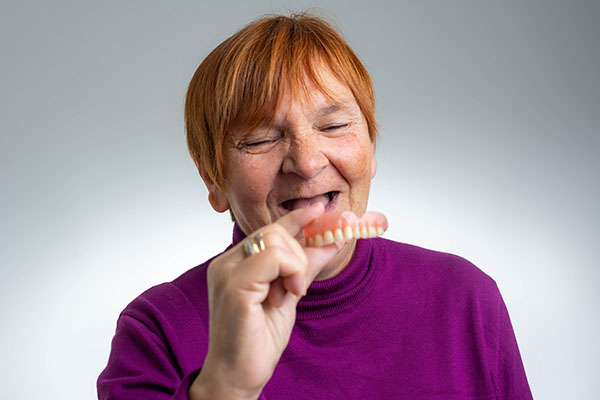
Adjusting to new dentures is a process that usually takes several weeks. You must learn how to eat, speak, and adapt to the feel of having them in your mouth. Though every effort is made to have your dentures fit correctly when they are made, you are likely to need to visit your dentist for adjustments.
Adjustments are made for various reasons. Your gums can develop sore spots and inflammation where the dentures touch, the plate might move when you laugh, or you may have difficulty eating. One cause of those problems is that the dentures are loose. Not only are loose dentures uncomfortable, but they also pose a health risk.
What causes loose dentures?
Your gums will be swollen for several weeks after your teeth are extracted and you are adjusting to new dentures. However, as the swelling goes down, your dentures may become loose. The most common reason is bone resorption; your gums will start to shrink because they are no longer holding your teeth in your mouth.
How can you deal with loose dentures?
If your dentures do not fit well, make an appointment with your dentist to discuss your options.
Denture adhesives
There are a few types of denture adhesives available. Denture creams and pastes are applied to your denture plate before you place it in your mouth. Once inserted, you push the denture onto your gum to form a bond. These keep the piece secure, but the paste or cream can be messy and difficult to clean up when you remove your dentures.
Denture adhesive powder also keeps your dentures in place, but it sometimes forms a stronger bond with your gums than creams or pastes do. Powders are spread in a light layer over wet dentures in the areas where they will be in contact with your gums. Powders do not ooze, and your end-of-the-day cleanup is easier.
Cushions or strips are the cleanest types of denture adhesive. They are pre-formed to fit the shape of your appliance and can be cut with scissors if necessary. Wet the cushion and place it onto the denture, then press the denture into place in your mouth. When you remove your dentures, there is no residue in your mouth, and cushions easily peel away from the appliance.
Adjustment by your dentist
Sometimes, loose dentures fit better after your dentist grinds problem areas on your denture plate. However, your dentures may need to be relined if a minor adjustment does not fix the problem.
There are two kinds of relining: Soft and hard. With soft relining, a polymer is added to the inside of the denture tray. The tray is placed into your mouth, and the polymer conforms to the shape of your gums. Hard denture plastic is used for hard relining.
Should you be concerned about loose dentures?
Adjusting to new dentures is easier when the appliances fit correctly. While slightly loose dentures are normal during this period, they are uncomfortable and are a health risk. If your dentures are moving in your mouth, work with your dentist to find the solution that is right for you.
Request an appointment or call Dr. Charles Arp, DDS & Dr. Smriti Bajaj, DMD at 404-682-2887 for an appointment in our Atlanta office.
Related Posts
Adjusting to new dentures may seem intimidating, but it is easy if you take an informed approach. There is little to worry about as long as you begin your journey with the right set of knowledge and a positive attitude.If you have never worn them before, dentures can feel strange. Have no fear. Expect that…
Adjusting to new dentures can involve several changes to a person's routine. One thing that should stay the same, however, is regular dentist appointments. Here is what a new patient needs to know about the importance of dentist appointments and how often he or she needs to visit the dentist after receiving dentures.One commonly asked…
When adjusting to new dentures, a patient will likely have a long list of questions. Can dentures be slept in? How does wearing dentures change a person's oral hygiene routine? Here you will find the answers to these and more information about a nightly care routine for those who are adjusting to new dentures.When adjusting…